
/ Art
Abraham
2020
Abraham examines the relationship between photography, technological progress, and ecological time through an abandoned swimming pool gradually absorbed by vegetation. Photographed on Kodak Aerochrome infrared film, the site becomes a space where human ruin encounters ecological regeneration. What appears as decay from the perspective of historical time may, within planetary time, represent only a transition between different states.

Installation views
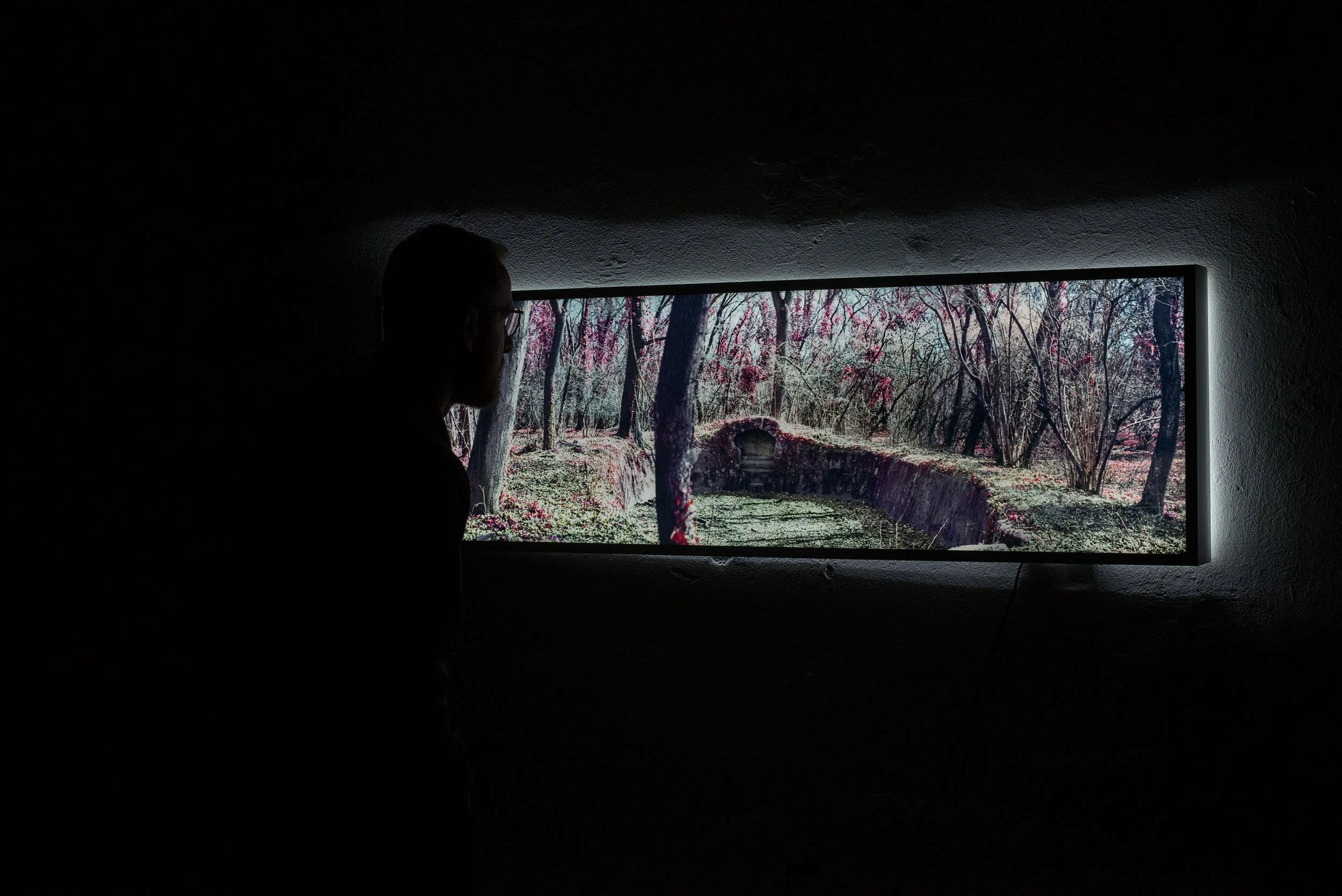


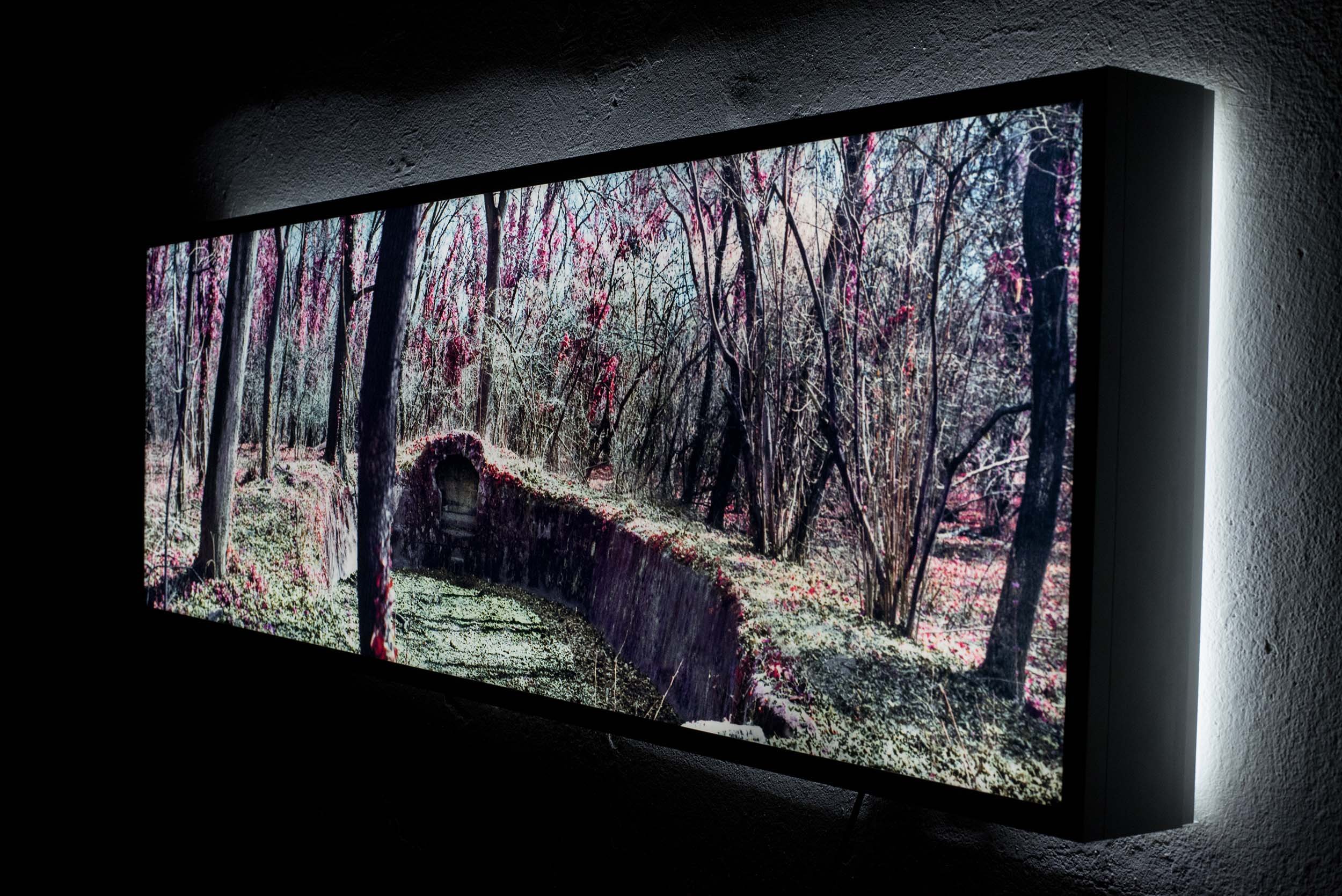
About the project
Abraham examines the relationship between photography, technological progress, and ecological time through an image of an abandoned, approximately 120-year-old swimming pool gradually absorbed by vegetation. Photographed on Kodak Aerochrome—a discontinued infrared film originally developed for aerial reconnaissance and later used to detect changes in vegetation—the landscape appears in an altered spectrum, making visible information that conventional photographic materials cannot register.
The film's historical function introduces a paradox into the work. Technologies developed to observe, measure, and understand the environment are themselves embedded within systems of technological production that contribute to its transformation. Photography becomes both an instrument of knowledge and part of the technological condition it attempts to examine.
The abandoned pool further complicates this relationship. A structure created to contain and control water has lost its original function and is gradually being incorporated into another ecological system. What a human might perceive as decay, abandonment, or even a post-apocalyptic landscape may, on a different temporal scale, represent a process of succession and regeneration. Human ruin becomes ecological transition.
This shift in perspective places historical time against planetary time. The lifespan of architecture, technology, and even human civilization becomes only a brief interval within ecological and earth processes that exceed individual experience. Drawing on C. S. Holling’s understanding of ecosystems as adaptive cycles of growth, conservation, disruption, and reorganization, Abraham considers destruction not necessarily as an endpoint, but as a possible transition between different states.
The work therefore does not imagine a landscape after the end of the world, but questions whose world is ending. Through a film material originally designed to extend human vision beyond the visible spectrum, Abraham confronts the limits of another form of vision: our ability to perceive environmental transformation beyond the scale of human time.
Selected exhibitions
2022 Photogether Gallery, Zlín, Czech Republic
2020 Artrooms Moravany, Kaštieľ Moravany, Moravany nad Váhom, Slovakia